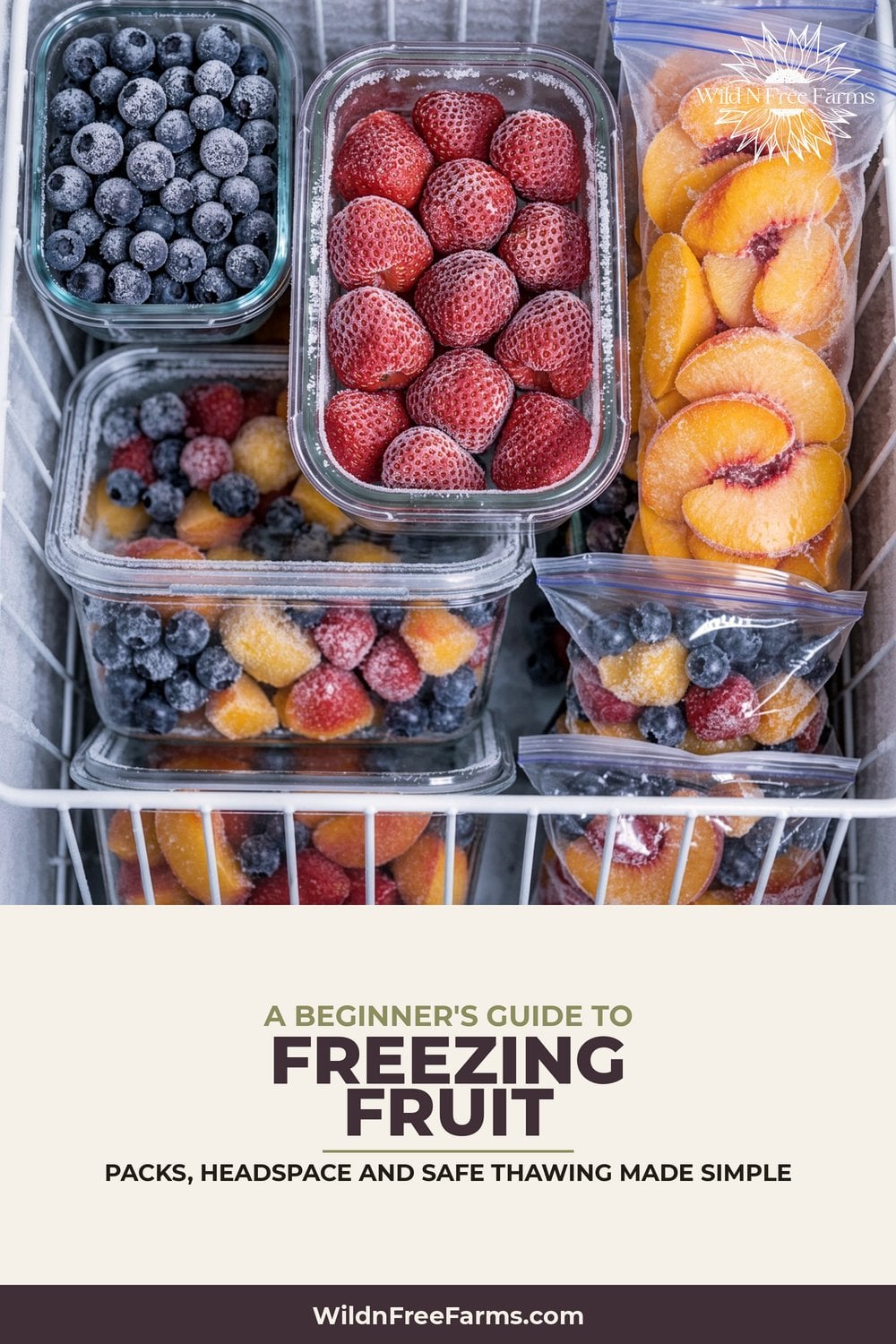
How to Freeze Fruit: A Beginner’s Guide to Packs, Headspace and Thawing
If your counter is piled with berries, peaches, or apples that are ripening faster than you can eat them, learning how to freeze fruit is one of the easiest ways to save the harvest. It takes no canner, no hot kitchen, and very little time. A few good habits at the start decide whether you pull out bright, flavorful fruit in February or a freezer bag of icy, brown mush.
In this beginner’s guide, I’ll walk you through the four ways to pack fruit for the freezer, the containers and headspace to use, how to keep fruit from darkening, how long it keeps, and the safe way to thaw it. Everything comes from the National Center for Home Food Preservation (NCHFP) and the University of Georgia Cooperative Extension, so it works the same wherever you live.

Disclaimer
This post contains affiliate links, so we may earn a commission if you sign up or buy through them, at no added cost to you. It helps support our content, and I only share what I truly believe in or use. As an Amazon Associate I earn from qualifying purchases. We also run ads on many articles. See our disclaimer and disclosure page for details.
Freezing does not sterilize food. As the NCHFP explains, the extreme cold slows the growth of microorganisms and the chemical changes that affect quality or cause spoilage. That’s why the details of packing, temperature, and thawing matter.
Why Freeze Fruit?
Freezing is one of the easiest, most convenient, and least time-consuming ways to preserve food, according to the NCHFP. For fruit, it’s especially useful because it holds onto fresh flavor better than most other methods. A tray of berries picked at their peak can taste close to summer in the middle of winter.
- It’s Fast: Most fruit goes from the cutting board to the freezer in minutes, with no processing time.
- It Saves the Glut: Freeze what you can’t eat this week and use it for smoothies, pies, jam, sauces, and baking later.
- It Keeps Fruit Close to Fresh: The NCHFP says freezing cannot improve flavor or texture, but when it’s done properly it preserves most of the quality of the fresh product.
- It Pairs With Other Methods: Freeze extra berries now and make jam, syrup, or sauce when you have time.
One honest note: the NCHFP points out that frozen fruit has a softer, mushier texture once it thaws. That’s normal, and it’s why frozen fruit shines in smoothies, baking, sauces, and oatmeal more than in a fresh fruit salad.
What You Need to Freeze Fruit
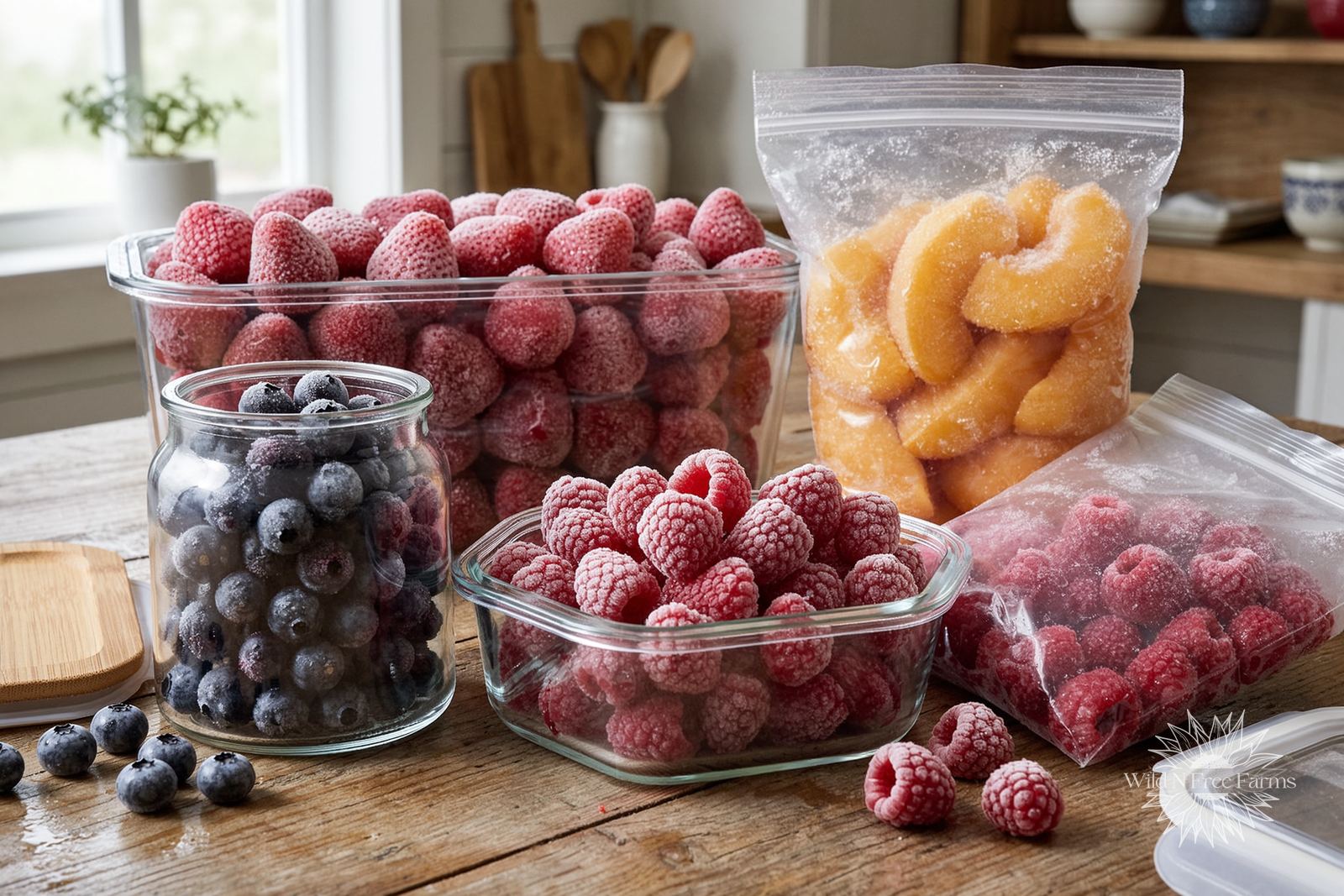
You don’t need much, but the right container matters. The NCHFP says food for the freezer needs packaging that resists moisture vapor, is durable and leakproof, doesn’t turn brittle in the cold, and keeps out off flavors and odors. There are two types for home use: rigid containers and flexible bags or wraps.
- Rigid Plastic or Glass Containers: Suitable for all packs and especially good for syrup or juice packs. Straight sides make frozen fruit easier to get out. Cardboard cartons from cottage cheese or ice cream are not moisture-vapor resistant enough unless they’re lined with a freezer bag.
- Freezer Bags: Good for dry-packed fruit and irregular shapes. Press out as much air as possible before sealing.
- Size: Don’t freeze fruits or vegetables in containers larger than half a gallon. Bigger containers freeze too slowly for a good result.
If you use glass, the NCHFP warns that regular jars break easily at freezer temperatures. Choose wide-mouth jars made for both canning and freezing, such as these Ball wide-mouth pint jars, because they’re tempered for temperature extremes and the wide mouth lets you remove partly thawed fruit. If you use standard narrow-mouth jars, leave extra headspace so the expanding liquid doesn’t break the jar at the neck. Always fit lids tightly, and use freezer tape if a lid is loose.
You’ll also want a rimmed baking sheet for tray freezing (a basic half sheet pan works well), parchment paper, a marker or freezer labels, and a freezer thermometer. The NCHFP recommends keeping a thermometer in the freezer and checking it often, since foods lose quality much faster above 0°F (-18°C). An inexpensive dial model like this Taylor refrigerator and freezer thermometer does the job.
The Four Ways to Pack Fruit for the Freezer
Which pack you choose depends on the fruit and how you plan to use it. All four are straight from the NCHFP.
1. Dry Pack (No Sugar)
The NCHFP says a dry pack is good for small whole fruits, such as berries, that give a good quality product without sugar. You simply pack the fruit into a container, seal, and freeze. Cranberries, raspberries, blackberries, blueberries, and pineapple are all frozen this way.
2. Tray Pack (Loose, Pourable Fruit)
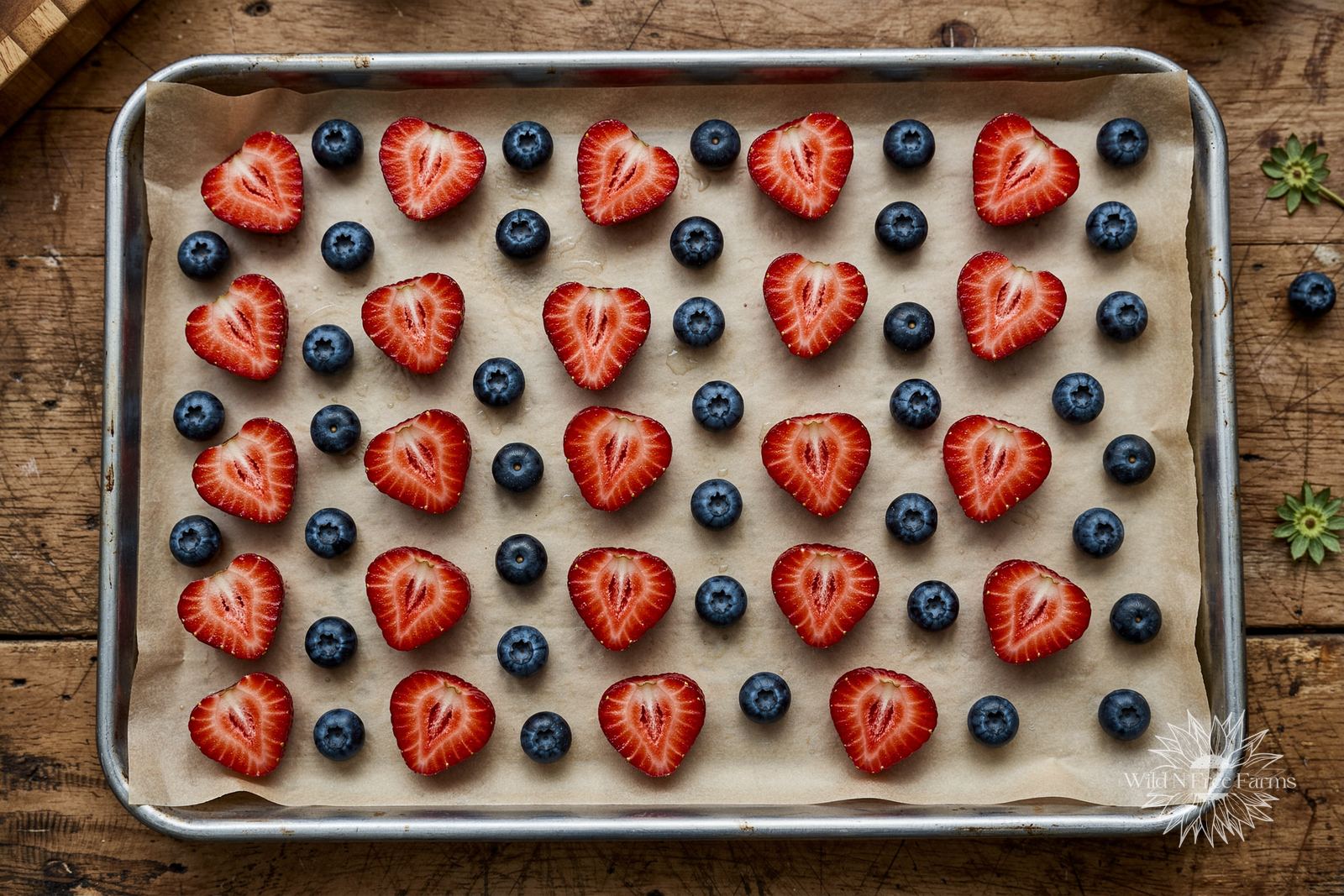
A tray pack is a dry pack with an extra step that keeps the fruit from clumping. Spread a single layer of prepared fruit on shallow trays and freeze. When it’s frozen, promptly package it and return it to the freezer. The pieces stay loose, so you can pour out just what you need and re-close the bag. Package the fruit as soon as it’s frozen, the NCHFP says, to prevent freezer burn.
3. Sugar Pack
For a sugar pack, mix dry sugar into cut or crushed fruit until most of it dissolves or the fruit sits about 15 minutes and makes its own juice, then pack it into containers. The NCHFP uses amounts such as 3/4 cup of sugar to 1 quart (1 1/3 pounds) of strawberries or raspberries, and 2/3 cup to 1 quart of peaches.
4. Syrup Pack
A syrup pack covers the fruit in cold sugar syrup. It’s the NCHFP’s preferred pack for apples used in uncooked desserts or fruit cocktail and works well for peaches, pears, and cherries. To make syrup, dissolve sugar in lukewarm water, mix until clear, and chill before using. Use just enough cold syrup to cover the fruit, about 1/2 to 2/3 cup per pint. The NCHFP syrup chart looks like this:
| Type of Syrup | Approx. Percent | Cups of Sugar | Cups of Water | Yield |
|---|---|---|---|---|
| Very Light | 10% | 1/2 | 4 | 4 1/2 cups |
| Light | 20% | 1 | 4 | 4 3/4 cups |
| Medium | 30% | 1 3/4 | 4 | 5 cups |
| Heavy | 40% | 2 3/4 | 4 | 5 1/3 cups |
| Very Heavy | 50% | 4 | 4 | 6 cups |
Up to one-fourth of the sugar can be replaced with corn syrup or mild-flavored honey. To keep fruit under the syrup, press a small piece of crumpled parchment paper or other water-resistant wrapping on top before sealing. See the NCHFP page on syrups for freezing fruit for the full details.
How to Freeze Fruit Step by Step
1. Start With Ripe, Firm Fruit
Choose fully ripe, firm, flavorful fruit and sort out anything bruised, soft, or defective. The NCHFP’s directions call for firm, fully ripe berries, apples that are crisp and not mealy, and peaches that are well-ripened and handled carefully to avoid bruising.
2. Wash, Trim, and Cut
Wash and drain berries, remove caps and stems, and peel, core, pit, or slice larger fruit as needed. One exception: the NCHFP says not to wash blueberries before freezing, because washing results in a tougher skin. Pack them dry and wash them just before you use them.
3. Keep Light-Colored Fruit From Darkening
Apples, peaches, pears, and bananas turn brown quickly. The NCHFP’s tested directions use ascorbic acid (vitamin C): for example, 1/2 teaspoon (1,500 mg) per quart of syrup for apples and peaches, 3/4 teaspoon per quart of syrup for pears, and 1/2 teaspoon per cup of mashed bananas. For a sugar pack of peaches, dissolve 1/4 teaspoon of ascorbic acid in 3 tablespoons of cold water and sprinkle it over each quart of fruit before adding sugar. For apple slices in a sugar or dry pack, the NCHFP says you can use ascorbic acid or steam blanch the slices for 1 1/2 to 2 minutes.
4. Pick Your Pack and Fill the Container
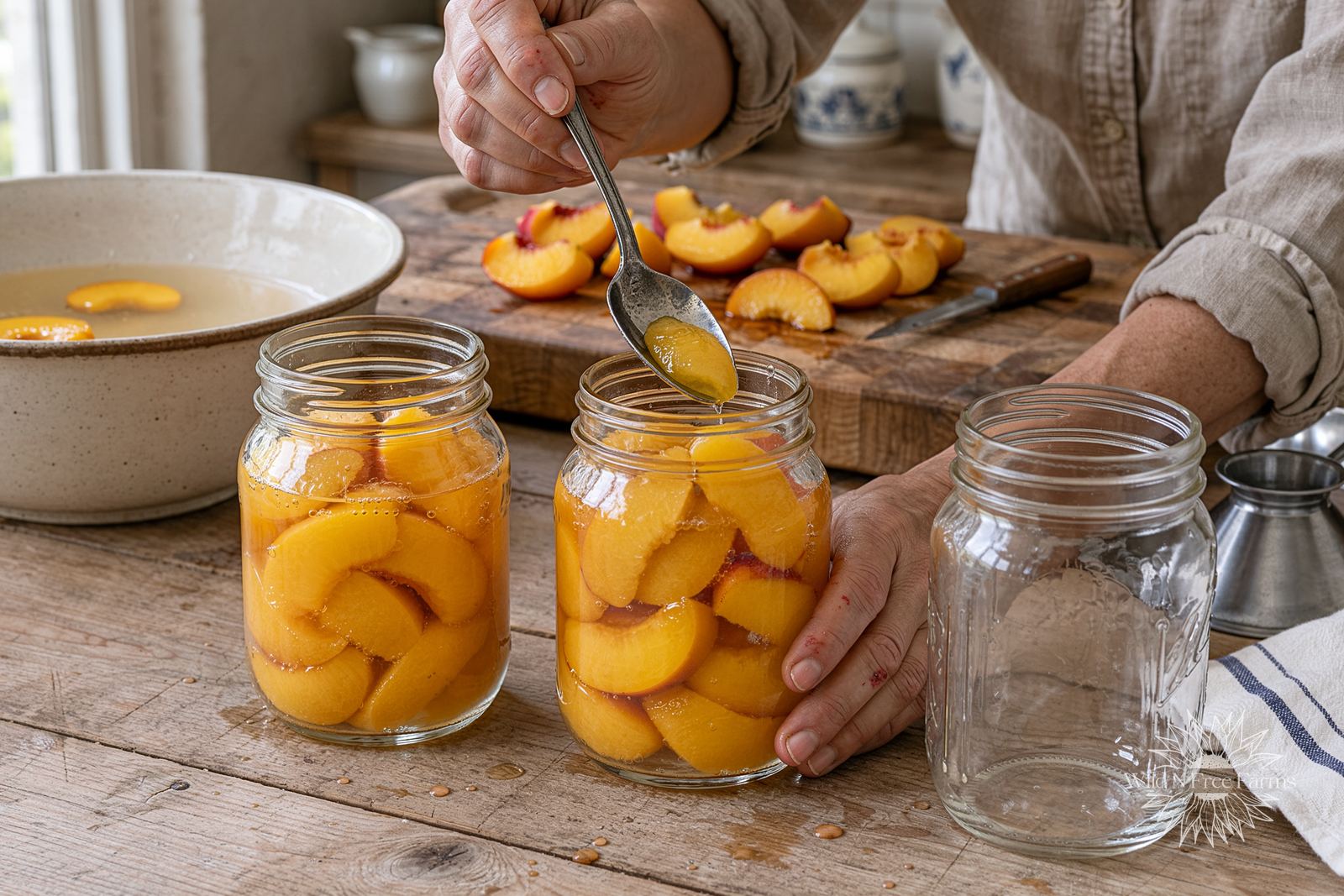
Follow the pack that suits your fruit (see the chart below). Pack fruit tightly, leaving as little air as possible, and leave headspace at the top. The NCHFP says most foods need headspace to allow for expansion as they freeze, while tray-packed foods are an exception.
5. Leave the Right Headspace
Use the NCHFP’s headspace guide:
| Type of Pack | Wide-Mouth Pint | Wide-Mouth Quart | Narrow-Mouth Pint | Narrow-Mouth Quart |
|---|---|---|---|---|
| Liquid pack (fruit in juice, sugar, syrup or water; crushed or puréed fruit) | 1/2 inch | 1 inch | 3/4 inch | 1 1/2 inches |
| Dry pack (no added sugar or liquid) | 1/2 inch | 1/2 inch | 1/2 inch | 1/2 inch |
| Juices | 1/2 inch | 1 inch | 1 1/2 inches | 1 1/2 inches |
6. Cool, Seal, Label, and Freeze
Cool the fruit and any syrup before packaging, which speeds up freezing and helps keep color, flavor, and texture. Pack amounts you’ll use at one time. Label each package with the name of the product, any added ingredients, the date, the amount, and the form of the fruit (whole, sliced, crushed). The NCHFP packaging guidelines recommend freezer tape, markers, or labels made for freezer use.
Then freeze right away. Per the NCHFP freezing pointers, freeze at 0°F (-18°C) or lower, place packages against the coldest part of the freezer, and don’t overload it. Add only as much unfrozen food as will freeze within 24 hours, which is usually 2 to 3 pounds per cubic foot of freezer space. Leave a little space between new packages so air can circulate, then stack them close together once they’re frozen. The NCHFP also suggests setting the freezer to -10°F (-23°C) or lower about 24 hours in advance for faster freezing.
How to Freeze Fruit: Packs for Common Fruits
Here are the NCHFP’s recommended packs for some of the fruits people freeze most. Always check the NCHFP page for your specific fruit for the full directions.
| Fruit | How the NCHFP Says to Freeze It |
|---|---|
| Strawberries | Whole berries in cold 50% syrup, or sugar pack with 3/4 cup sugar per quart (1 1/3 lb) of berries. Wash and remove caps first. |
| Blueberries | Dry pack or tray pack. Don’t wash before freezing; wash before using. |
| Raspberries | Dry pack or tray pack, sugar pack (3/4 cup per quart), or cold 40% syrup. |
| Blackberries | Cold 40 to 50% syrup, sugar pack (3/4 cup per quart), or dry pack and tray pack. |
| Cranberries | Dry pack or tray pack, or cold 50% syrup. Stem, sort, wash, and drain first. |
| Peaches and Nectarines | Peeled; cold 40% syrup with ascorbic acid, or sugar pack (2/3 cup per quart), or crushed or puréed. |
| Apples | Peeled, cored, and sliced; syrup pack (40%) with ascorbic acid for uncooked desserts, or sugar or dry pack for pies. |
| Pears | Heat in boiling 40% syrup for 1 to 2 minutes, drain, cool, then pack in cold 40% syrup with ascorbic acid. |
| Sweet Cherries | Washed, stemmed, and pitted; cold 40% syrup with ascorbic acid. |
| Citrus Sections | Peel, remove membranes and seeds, and pack in cold 40% syrup. Juice can be frozen in glass jars. |
| Melons | Cut into slices, cubes, or balls; cold 30% syrup or an unsweetened pack. |
| Pineapple | Dry pack, tightly packed without sugar. |
| Bananas | Mash with 1/2 teaspoon ascorbic acid per cup of mashed banana. |
Stay Up To Date
Enter your name and email to subscribe to our weekly newsletter, announements and freebies!
How Long Does Frozen Fruit Last?
The NCHFP lists about 8 to 12 months of storage for fruits and vegetables at 0°F, assuming the food was prepared and packaged correctly. For the best quality, use the shorter end of that range. After that time the food should still be safe, but it will be lower in quality.
Keep the storage temperature at 0°F or lower, because foods lose quality much faster at higher temperatures. The NCHFP freezer management guide also suggests keeping an inventory list near the freezer, arranging packages by food group, and using the oldest packages first. A full freezer is the most energy efficient, so refilling it a few times a year costs less per pound of stored food.
How to Thaw Frozen Fruit Safely
Food is safe indefinitely while frozen, says the NCHFP, but once it begins to defrost and warms above 40°F (4°C), any bacteria that were present can start to multiply. Never thaw food at room temperature or in warm water.
- In the Refrigerator: Allow about 6 to 8 hours to thaw a 1-pound package of fruit packed in syrup.
- Under Cold Running Water: Allow about 1/2 to 1 hour for a package in cool running water.
- In the Microwave: Only if you’ll use the fruit immediately.
Fruit packed with dry sugar thaws slightly faster than fruit packed in syrup, and both thaw faster than unsweetened packs. When serving frozen fruit as a dessert, the NCHFP suggests serving it while a few ice crystals remain, which helps make up for the softer texture.
Thaw only what you need. Leftover thawed fruit keeps better if you cook it. If a recipe was written for fresh fruit, remember that frozen fruit often has more juice, and any sugar you added before freezing counts toward the recipe’s sweetness. Use only part of the juice or add a little more thickener for pies and baked goods.
Frozen fruit works the same as fresh in pies, upside-down cakes, sherbets, and salads, and crushed or puréed fruit makes a good topping, filling, or jam base.
Common Mistakes When Freezing Fruit
- Using Oversized Containers: Containers over half a gallon freeze too slowly for a good result.
- Skipping Headspace: Liquids and juicy fruit expand as they freeze, which can break jars or pop lids.
- Using Regular Jars: Choose wide-mouth jars made for freezing. Standard jars can crack, especially at the neck.
- Overloading the Freezer: Adding too much warm or unfrozen food at once slows freezing and lowers quality.
- Warm Syrup or Fruit: Cool everything first.
- Washing Blueberries Early: It makes the skins tougher. Rinse them right before you use them.
- Skipping Labels: A frozen bag of berries and a frozen bag of purée look a lot alike. Label with the contents and date.
Freezing Fruit FAQs
Do I have to add sugar when I freeze fruit?
No. For small whole fruits like blueberries, raspberries, blackberries, and cranberries, the NCHFP describes dry and tray packs with no sugar. Sugar and syrup packs help fruit like peaches and apples hold color and flavor.
Can I freeze fruit in mason jars?
Yes, if you use wide-mouth jars made for canning and freezing and leave enough headspace. Standard narrow-mouth jars need extra headspace, and regular jars can break at freezer temperatures.
Where do I get ascorbic acid?
Pure ascorbic acid (vitamin C) powder is sold with canning supplies and online. The NCHFP directions measure it in teaspoons, and 1/2 teaspoon equals 1,500 mg, so follow the amount listed for each fruit.
Can I use frozen fruit in baking?
Yes, but allow for the extra juice. Our Lemon Blueberry Sourdough Bread recipe recommends fresh blueberries for the best texture, because frozen berries tend to release extra moisture and make the dough overly wet.
Start Freezing Your Fruit
Learning how to freeze fruit comes down to a few simple habits: pick ripe, firm fruit, choose the right pack, use the right container, leave headspace, label it, and keep your freezer at 0°F or below. Do that, and you’ll have summer flavor ready for smoothies, pies, and breakfast bowls long after the harvest is over. If you grow your own, our guides to growing strawberries, blueberry bushes, and blackberries will help you grow more to freeze.
Sources
- National Center for Home Food Preservation (University of Georgia). Freezing: General Information.
- NCHFP. Containers for Freezing.
- NCHFP. Dry or Tray Packing for Fruits.
- NCHFP. Syrups for Use in Freezing Fruits.
- NCHFP. Headspace to Allow.
- NCHFP. How Long Can I Store Frozen Foods.
- NCHFP. Thawing and Preparing Foods for Serving.
- NCHFP. Freezing Fruits (individual fruit pages, including strawberries, blueberries, apples, and peaches).